Fine hair can be surprisingly difficult to understand.
It is easy to assume that fine hair simply means having less hair.
But those are not necessarily the same thing.
Someone can have a considerable amount of hair while each individual strand remains relatively fine. The result can be a head of hair that looks full in some situations but feels lacking in body, particularly around the roots or after washing.
This distinction matters when choosing haircare.
A shampoo designed for fine hair should not simply attempt to make the hair feel squeaky clean or artificially large.
It needs to consider strength, manageability, volume and the way the hair behaves after cleansing.
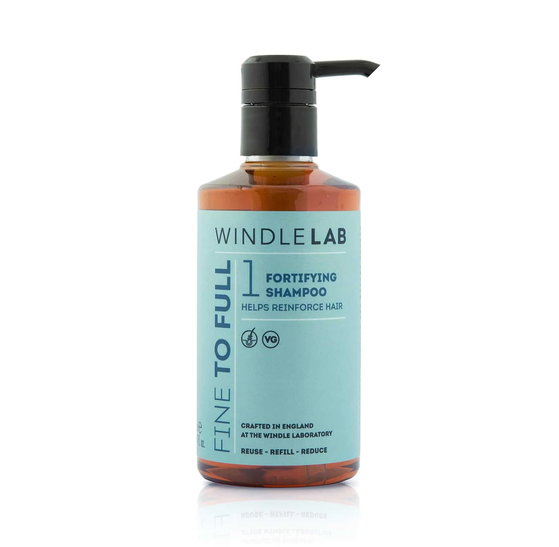
That is where Windle LAB Fine to Full Fortifying Shampoo becomes interesting.
The shampoo is part of Windle London’s Fine to Full regime, a collection developed specifically around fine and thinning hair. The brand positions the shampoo as a strengthening cleanser intended to reduce breakage while helping reinforce hair and promote a fuller appearance.
The important word here may be “fortifying.”
Fine hair often needs a careful balance.
If a shampoo is too rich, it can leave the hair flat.
If it is too aggressive, the hair may feel dry and difficult to style.
If cleansing is combined with appropriate strengthening support, the routine can take a more considered approach.
That is the thinking behind Fine to Full.
The shampoo’s formulation includes hydrolysed wheat protein and creatine, alongside rooibos extract and a group of conditioning and moisture-supporting ingredients. Windle London describes the wheat protein as helping strengthen the hair and reduce breakage, while rooibos is included for its antioxidant properties.
It is worth putting these claims into perspective.
A shampoo is a rinse-off product.
It has limited contact time with the hair compared with a leave-in treatment.
It would therefore be unrealistic to expect a cleanser alone to completely transform the density of someone’s hair.
What a well-designed shampoo can do is support the condition of the hair and create a better foundation for the products that follow.
That distinction makes the Fine to Full approach more interesting.
The shampoo is not being asked to do everything.
It is the first stage of a wider routine.
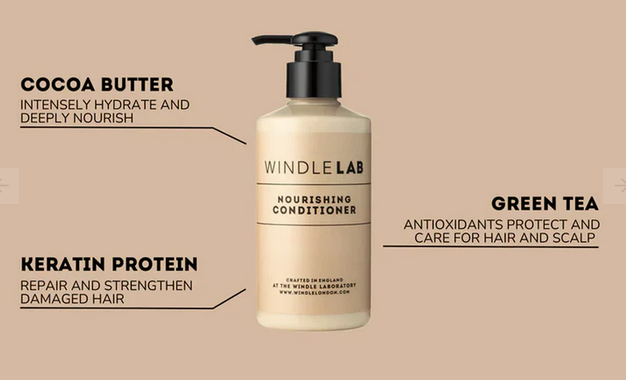
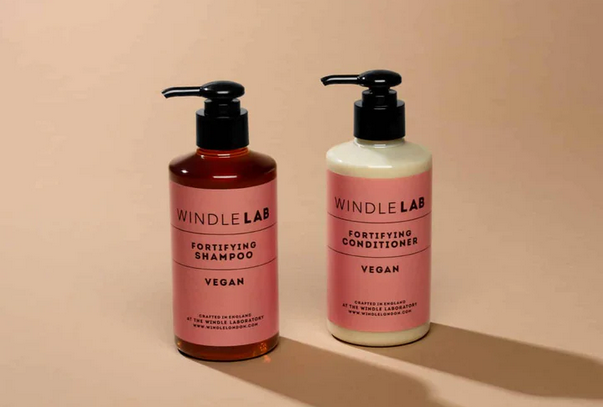
The current Fine to Full regime combines the Fortifying Shampoo with a Fortifying Conditioner and Hair Density Treatment, followed by styling support from Thickening Cream.
This is a logical progression.
The shampoo cleanses.
The conditioner supports the lengths.
The density treatment is designed to target the scalp and hair density.
The styling product creates an immediate fuller appearance.
Each stage has a different purpose.
That is considerably more realistic than expecting one bottle to solve every concern associated with fine hair.
One of the most common complaints about fine hair is that it becomes flat quickly.
The hair may look impressive immediately after a professional blow-dry but lose volume once it encounters humidity, sleep or simply the passage of time.
Part of the issue is structural.
Fine strands have less diameter than coarse strands, so they often have less natural stiffness.
They can lie closer together and collapse more easily.
That does not mean fine hair is unhealthy.
It simply behaves differently.
A shampoo designed specifically for this type of hair therefore needs to cleanse without unnecessarily compromising the hair’s condition.
The Fine to Full formula is sulphate-free, according to Windle London’s product information, using milder surfactants rather than traditional sulphate cleansers.
That is relevant because aggressive cleansing can be counterproductive for hair that is already fragile or prone to breakage.
But “mild” should not be confused with ineffective.
A shampoo still needs to remove sebum, styling residue, environmental dirt and the accumulation of previous products.
The ideal result is hair that feels clean without feeling stripped.
This is particularly important when styling products are used regularly.
Fine hair can sometimes require products to create volume and hold, but repeated styling can leave residue behind.
The cleansing stage needs to reset the hair without making it unnecessarily dry.
This is where a fortifying shampoo has an interesting role.
The objective is not simply to produce a clean feeling.
It is to create a suitable starting point for the rest of the routine.
The inclusion of hydrolysed wheat protein is also worth considering.
Proteins are widely used in haircare because they can interact with the hair fibre and contribute to improved feel and strength. Windle London describes the wheat protein in this formulation as helping reinforce the hair and reduce breakage.
Again, it is better to think of this as supportive care rather than a permanent structural transformation.
Hair that experiences less mechanical stress can retain its length and appearance more effectively.
That can be particularly useful for someone whose fine hair tends to break during brushing or styling.
The distinction between breakage and hair loss is important here.
They are not the same thing.
Hair can appear thinner because strands are breaking.
It can also appear thinner for reasons unrelated to breakage.
A cosmetic shampoo should not be treated as a medical solution to unexplained hair loss.
Anyone experiencing significant or sudden changes in hair density should seek appropriate professional or medical advice.
Within the normal context of haircare, however, reducing unnecessary breakage and improving the appearance of fine hair can be worthwhile goals.
This is also where the idea of “fuller-looking” hair becomes more realistic.
A product does not necessarily need to increase the actual number of hairs on the scalp to make hair look fuller.
Hair can appear more substantial when the strands are in better condition, when they are not excessively weighed down and when styling creates more lift.
The Fine to Full system addresses several of these factors from different directions.
That makes the overall concept more interesting than the shampoo alone.
It also demonstrates why professional haircare can be more nuanced than simply selecting products according to labels.
A stylist can look at the hair and identify what is actually limiting the result.
Is the hair fine?
Is it damaged?
Is it being weighed down by the wrong conditioner?
Is the haircut removing too much density?
Is the styling technique flattening the roots?
Is there breakage?
Or is the client concerned about genuine thinning?
These are very different situations.
The correct response will be different for each.
Windle London’s professional background is relevant here because the company’s haircare range has been developed alongside its salon experience. The current Fine to Full system is explicitly positioned for fine and thinning hair, combining cleansing, conditioning, density treatment and styling.
The shampoo itself therefore makes the most sense when considered as part of that larger philosophy.
It is not simply about washing fine hair.
It is about creating a better starting point for making fine hair look and feel stronger and fuller.
There is also something appealing about the simplicity of the first step.
A good routine does not need to begin with something complicated.
It begins with cleansing.
The difference lies in choosing a cleanser that respects the characteristics of the hair.
For fine hair, that means avoiding unnecessary heaviness while still providing enough care to keep the strands manageable.
The experience after washing becomes an important part of the review.
Hair should feel clean.
It should not feel coated.
It should remain light enough to style.
The roots should be capable of taking volume.
The lengths should feel sufficiently conditioned once the next step has been applied.
These details matter more than dramatic claims.
A shampoo that quietly performs its job well can have a greater impact on a routine than an exciting product that creates a striking result only occasionally.
Fine to Full Fortifying Shampoo appears to take that more measured approach.
It is designed to support strength and volume while forming the cleansing foundation of a wider routine.
That is probably the most sensible way to evaluate it.
Not as a standalone answer to every concern associated with fine hair, but as the first step in a system.
For someone exploring professional approaches to managing fine hair, Windle London’s Fine to Full collection offers an example of how cleansing, conditioning, targeted treatment and styling can be considered together rather than as unrelated products.
Ultimately, fine hair does not need to be treated as a problem that must be disguised.
It simply needs to be understood.
The right haircut can preserve the appearance of density.
The right shampoo can cleanse without unnecessary heaviness.
The right conditioner can improve manageability without flattening the roots.
The right styling product can create lift.
And a consistent routine can help the hair remain easier to handle over time.
That is a more realistic definition of “fine to full.”
Not changing what the hair fundamentally is.
But making better use of what is already there.
And when the routine is designed around the actual characteristics of the hair, even fine strands can look surprisingly substantial.